

Data suggests traders view $46,000 as Bitcoin’s final line in the sand
Dec. 13 will seemingly be remembered as a “bloody Monday” after Bitcoin (BTC) value misplaced the $47,000 assist, and altcoin costs dropped by as a lot as 25% inside a matter of moments.
When the transfer occurred, analysts shortly reasoned that Bitcoin’s 8.5% correction was immediately linked to the Federal Open Market Committee (FOMC) meeting, which starts on Dec. 15.
Investors are afraid that the Federal Reserve will eventually start tapering, which simply put, is a reduction of the Federal Reserve’s bond repurchasing program. The logic is that a revision of the current monetary policy would negatively impact riskier assets. While there’s no way to ascertain such a hypothesis, Bitcoin had a 67% year-to-date gain until Dec. 12. Therefore, it makes sense for investors to pocket those profits ahead of market uncertainties and this could be connected to the current correction seen in BTC price.
Bitcoin price retraced 8.2% over the past week, but it also outperformed the broader altcoin market. That is in stark contrast to the last 50 days because the leading cryptocurrency’s market share (dominance) dropped from 47.5% to 42%. Investors could have simply fled to Bitcoin due to its relatively smaller risk than altcoins.
Tether’s discount bottomed at 4%
The OKEx Tether (USDT) premium or low cost measures the distinction between China-based peer-to-peer (P2P) trades and the official U.S. greenback foreign money. Figures above 100% point out an extreme demand for cryptocurrency investing. Then again, a 5% low cost normally signifies heavy promoting exercise.
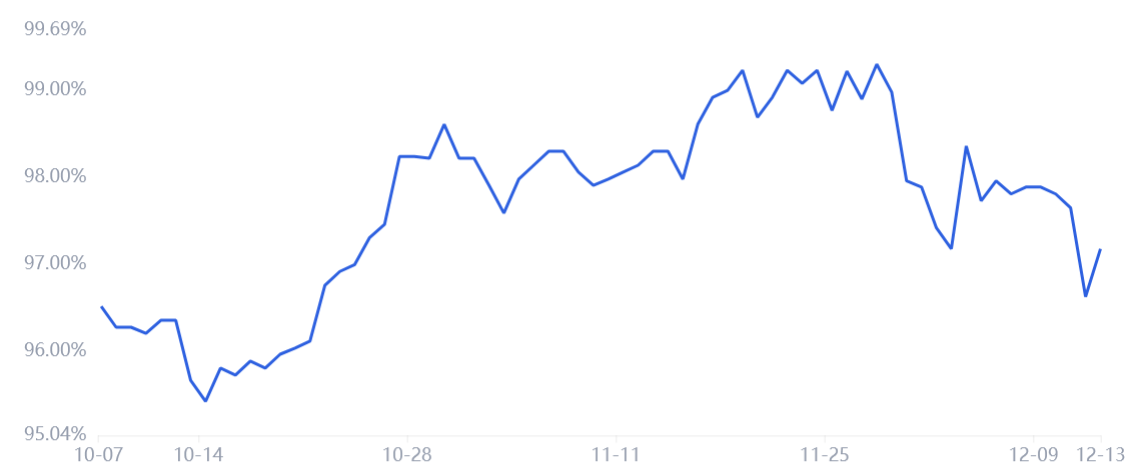
The Tether indicator bottomed at 96% on Dec. 13, which is barely bearish however not alarming for a ten% whole cryptocurrency market capitalization drop. Nonetheless, it has been over two months since this metric surpassed 100%, signaling an absence of pleasure from China-based merchants.
To additional show that the Dec. 13 value crash solely barely impacted investor sentiment, the full liquidations over the 24 hours was $400 million.
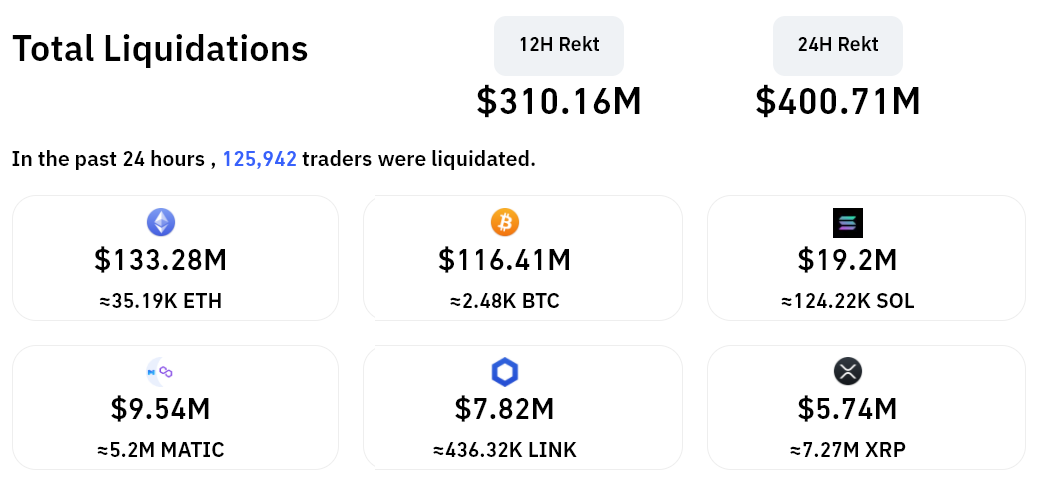
Extra importantly, solely $300 million of lengthy leverage contracts have been forcefully terminated as a consequence of inadequate margin. This determine appears insignificant when in comparison with the Dec. 3 crash, when $2.1 billion of leveraged patrons had their positions closed.
There’s no extreme demand from Bitcoin bears, in the intervening time
To additional show that the crypto market construction was not strongly affected by the sharp value drop, merchants ought to analyze the perpetual futures. These contracts have an embedded charge and normally cost a price each eight hours to stability the trade’s threat.
A optimistic funding charge signifies that longs (patrons) are demanding extra leverage. Nonetheless, the alternative state of affairs happens when shorts (sellers) require further leverage, and this causes the funding charge to show unfavorable.
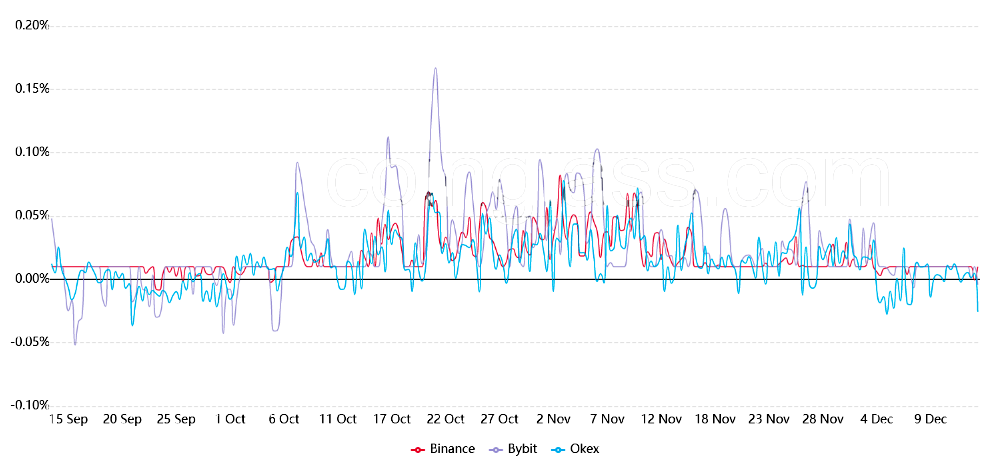
Contemplating that almost all cryptocurrencies suffered appreciable losses on Dec. 13, the general market construction held properly. Had there been extreme demand for shorts who have been betting on a Bitcoin value drop under $46,000, the perpetual futures eight-hour funding would have gone under 0.05%.
Tether buying and selling at a 4% low cost within the China-based markets, $300 million in lengthy contract liquidations and a impartial funding charge shouldn’t be an indication of a bear market. Until these fundamentals change considerably, there isn’t any purpose to name for $42,000 or decrease Bitcoin costs.
The views and opinions expressed listed below are solely these of the author and don’t essentially mirror the views of Cointelegraph. Each funding and buying and selling transfer includes threat. You need to conduct your individual analysis when making a call.